
If you pay freelancers, contractors, or other independent pros, the $600 rule is probably burned into your brain. Pay someone $600 or more in a year, send them a 1099. That number stuck around for decades. For 2026, it finally changed.
Thanks to the One Big Beautiful Bill Act, signed into law in July 2025, the 1099 threshold for 2026 is now $2,000. It's one of the biggest shifts in contractor reporting in a long time, and it lands right as you're thinking about year-end and the January filing rush. Here's what the new 1099 rules mean for your business, what stayed the same, and how to get ready now so January feels calm instead of chaotic.
What Changed: The New $2,000 1099 Threshold
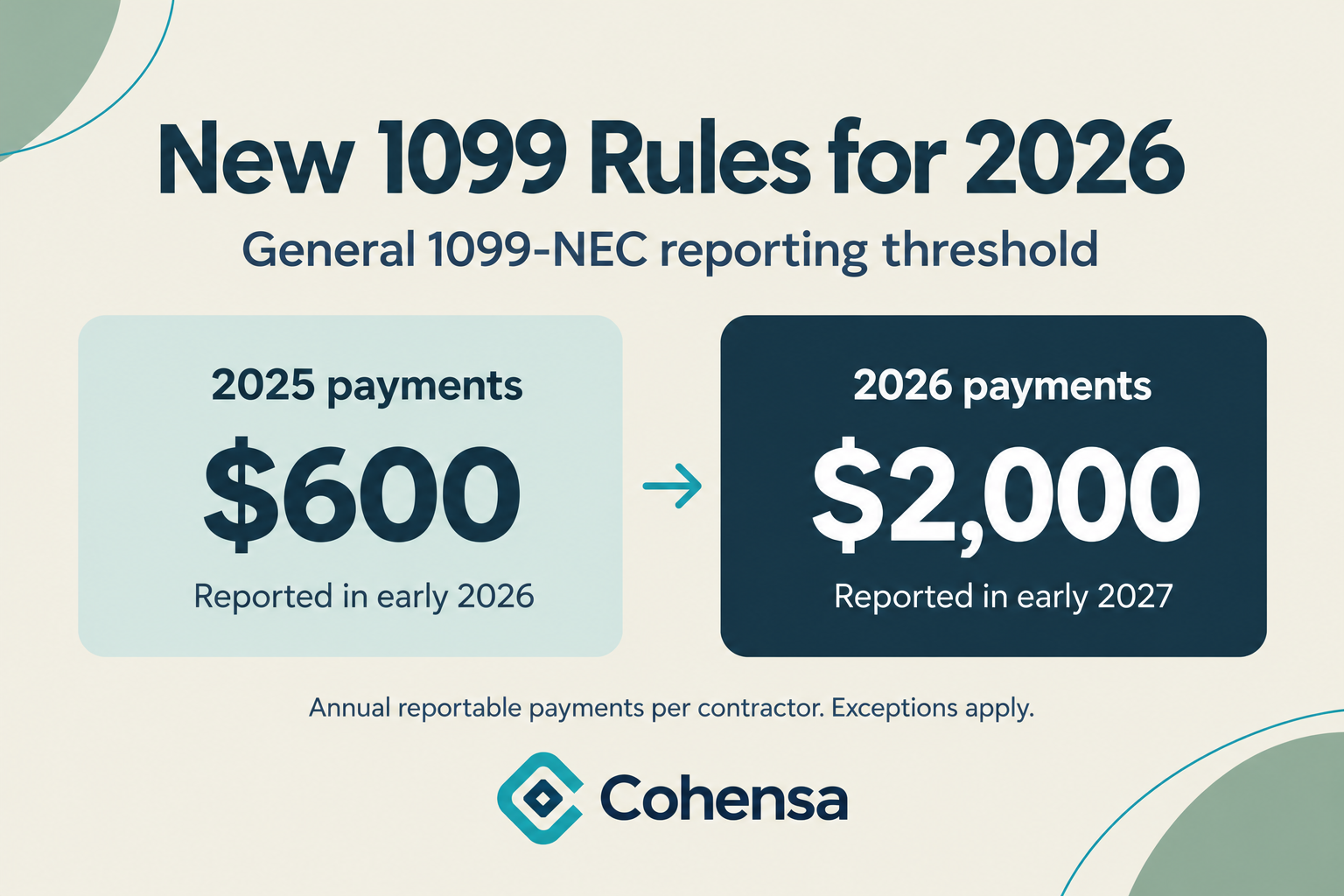
Starting with payments made on or after January 1, 2026, you only need to issue Form 1099-NEC to a contractor when you've paid them $2,000 or more for services during the calendar year. The same $2,000 threshold applies to most payment types on Form 1099-MISC, like rent, prizes, and awards.
A few details worth knowing:
Timing: The new threshold applies to money you pay in 2026. That means the forms you file in early 2027 are the first ones affected. The 1099s you filed earlier this year (for 2025 payments) still used the old $600 rule.
Inflation adjustments: Starting in 2027, the threshold will adjust for inflation each year, so expect the number to creep up over time.
Backup withholding: The backup withholding rules now line up with the $2,000 threshold too.
Royalties: These still have a $10 reporting threshold. That one didn't move.
A Quick Example
Say you run a small marketing studio and hired three freelancers this year:
A graphic designer you paid $1,500 for a logo refresh
A copywriter you paid $4,200 across several projects
A photographer you paid exactly $2,000 for a product shoot
Under the old rules, all three would get a 1099-NEC. Under the new 1099 rules for 2026, only the copywriter and the photographer do. The photographer hits the $2,000 mark, so they still get one. The designer falls below it, so no form is required.
That's less paperwork. But notice that it still takes good tracking to know who lands where.
Not sure which of your contractors need a 1099? Our free 1099 decision guide walks you through it.
What Didn't Change
The higher threshold is great news, but it isn't a free pass on the rest of the rules.
Income is still income. Your contractor has to report every dollar they earn, whether or not they get a 1099 from you. On your end, those payments are still business expenses you'll want documented for your own taxes.
Deadlines are still tight. Form 1099-NEC is due to both the IRS and your contractor by January 31. Since January 31, 2027 falls on a Sunday, the deadline for 2026 payments is Monday, February 1, 2027. There's no automatic extension for the IRS copy.
W-9s still matter. Collecting a Form W-9 before you pay a contractor is still the easiest way to get their legal name, tax ID, and business type. It's a lot less painful than chasing it down in late January.
Corporations are generally still exempt. Payments to C corps and S corps usually don't need a 1099-NEC. The big exception is attorneys, who generally get one no matter how their business is set up.
E-filing rules still apply. If you file 10 or more information returns in a year, you're required to file them electronically.
Your state may have its own rules. Not every state automatically follows federal changes, so it's worth confirming what yours requires.
Don't Forget About the 1099-K
If you pay contractors with a credit card or through a payment platform like PayPal, those payments are generally reported by the platform on Form 1099-K, not by you on a 1099-NEC. That keeps the same income from being reported twice.
The same law also reset the 1099-K threshold to more than $20,000 in payments and more than 200 transactions. That threshold had been scheduled to drop much lower, so this is welcome relief if your business receives payments through these platforms too.
How to Get Ready Before January
Year-end is the perfect time to get ahead of this. A little cleanup now saves a lot of scrambling later.
Pull a contractor payment report. Most accounting software, including QuickBooks, can show you the total paid to each vendor for the year.
Flag who's at or near $2,000. The total is for the whole calendar year, so someone at $1,800 in October could easily cross the line by December.
Sort by how you paid. Separate card and payment app payments (1099-K territory) from checks, ACH, and direct deposits (1099-NEC territory).
Check your vendor settings. Make sure the right vendors are marked as 1099-eligible and that your software is using the updated $2,000 threshold.
Collect missing W-9s now. Reach out before the holidays, while people are still answering emails.
Keep clean records for everyone. Even contractors under $2,000 should have invoices and payment records on file.
If your records need some attention first, our guide to catching up on bookkeeping is a practical place to start.
The Bottom Line
The new $2,000 1099 threshold means fewer forms for a lot of small businesses, especially if you work with freelancers on smaller projects. The core habits haven't changed, though. You still need to know who you paid, how much, and how. You still need W-9s. And you still need to hit that early deadline.
Want a simple way to sort out who needs a 1099? Download our free 1099 decision guide.
The good news? If you start tracking now, January becomes a quick checklist instead of a stressful scavenger hunt. If you'd rather not spend December digging through vendor reports, that's exactly the kind of behind-the-scenes work Cohensa handles. Reach out to us and we'll help you get your contractor records and books ready before January.
